


Natural Factors
Magnesium Bisglycinate Pure 200 mg
Magnesium Bisglycinate Pure 200 mg
Magnesium Bisglycinate fits easily into your daily routine, helping you feel ready to take on whatever is ahead. It’s made with a gentle, well-absorbed form of magnesium that’s easy on the stomach.. Whether you prefer capsules or mixable powder, each format is designed to work with your lifestyle, not against it.
- Helps maintain proper muscle function, including the heart muscle
- Helps in the development of bones and teeth
- Helps in energy metabolism and tissue formation
- Source of an electrolyte and helps maintain normal electrolyte balance
- Bisglycinate form is easy on the stomach
- Convenient daily capsules – ideal for travel or on-the-go
SKU:1641
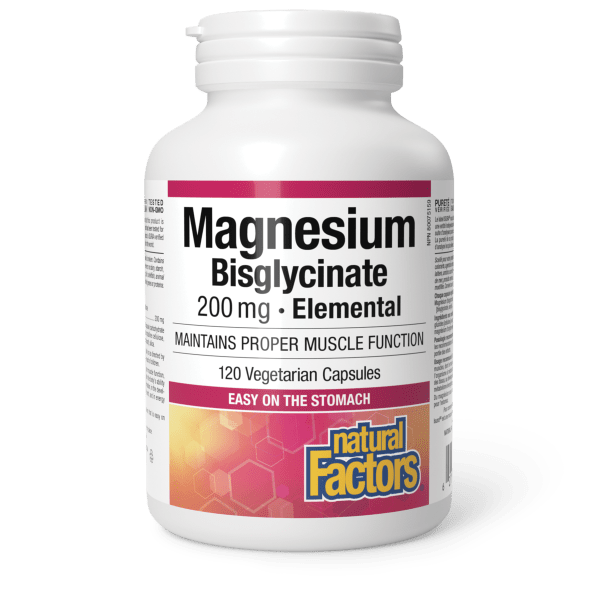


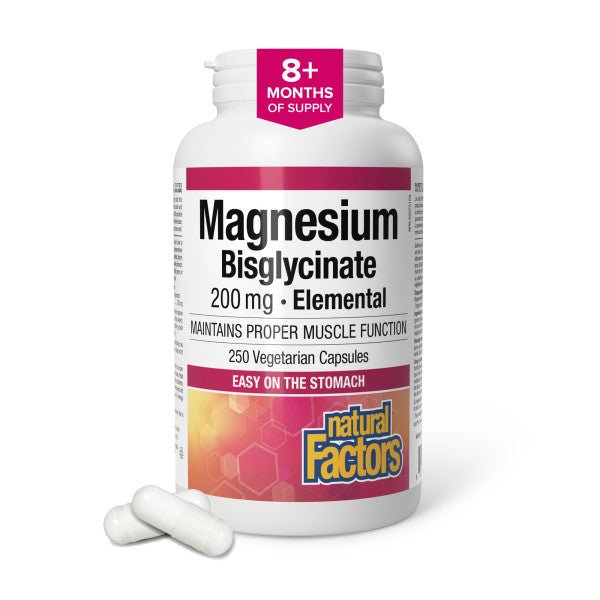
Magnesium Bisglycinate Pure 200 mg 200 mg Vegetarian Capsules
What Else Should I Know?
Medicinal Ingredients
| Each vegetarian capsule contains: | |
| Magnesium (buffered magnesium bisglycinate [bisglycinate, oxide]) | 200 mg |
Non-medicinal Ingredients
Vegetarian capsule (carbohydrate gum [cellulose], purified water), microcrystalline cellulose, vegetable grade magnesium stearate (lubricant), silica.
Dosage
Recommended adult dose: 1 capsule daily or as directed by a health care practitioner.
Caution
Keep out of the reach of children.
Allergy Information
Contains no artificial colours, preservatives, or sweeteners; no dairy, starch, sugar, wheat, gluten, yeast, soy, corn, egg, fish, shellfish, animal products, salt, tree nuts, or genetically modified genes or proteins. Suitable for vegetarians/vegans.
Overall rating: 0.0 / 5 from 0 reviews.
AI Generated Review Summary
Summary topics
Review topics: [].
Review highlights
Reviews
Q&A
- How much magnesium oxide is in each capsule
- Hi Lynn, Natural Factors Magnesium Bisglycinate Pure provides 200 mg of this essential mineral to help maintain proper muscle function. Natural Factors products always list the potency of minerals in elemental values on labels. Therefore, the magnesium content is represented as the elemental magnesium value. This non-GMO, vegan-friendly magnesium powder is easy on the stomach and does not rely on stomach acid for absorption. Just one daily serving mixed into water can restore magnesium levels to support energy metabolism, muscles, bones, and teeth. We hope you find this helpful!
- How much glycine is in each capsule of your magnesium bisglycinate?
- Thank you for your inquiry regarding Natural Factors Magnesium Bisglycinate Pure 200 mg (SKU 1641); we appreciate you taking the time to contact us. Our Magnesium Bisglycinate 200mg is a blended formula that contains magnesium bisglycinate, magnesium oxide, and free glycine, providing 200mg of elemental magnesium. While the exact ratio of our magnesium oxide to magnesium bisglycinate is proprietary, we can confirm that magnesium oxide will chelate in the presence of liquid in our digestive system, so the unbound magnesium from the magnesium oxide complex can then bind with free glycine, to allow for better bioavailability in the gastrointestinal tract.